Since 2010, Tecnalia R&I, the University of Ljubljana, Iamcut and Ad-hoc Desarrollo Sostenible have been working on systems to transform water- and abrasive-based cutting technology into water- and ice-jet cutting technology, so that in future it will be possible to dispense with the use of mineral abrasives.
The use of abrasives increases the cost of the process; it is responsible for most of the waste produced; and, furthermore, these particles often become embedded in the machined workpiece, which is why it is often necessary to use a jet free of abrasive particles. However, ice particles are less hard and therefore have a lower cutting efficiency than mineral abrasives, although their efficiency is greater than that of a water jet…
However, ice particles are less hard and therefore less effective at cutting than mineral abrasives, although they are more effective than a jet of plain water.
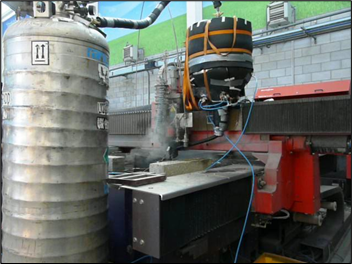
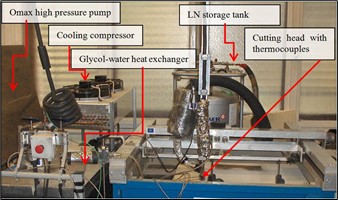
During the ICEJET project, two different technologies for creating a jet of ice particles were developed in parallel. In one of these, the ice particles are generated in a reservoir separate from the cutting head and are subsequently injected into the high-pressure water jet. In the other method, ice particles are generated on the spot by injecting liquid nitrogen directly into the cutting head, thereby freezing or transforming the water jet.
Technology 1
In this case, efforts have focused on the production of ice particles, as it is necessary to ensure that there is a sufficient quantity of particles of the right size, and on transporting them to the cutting head.
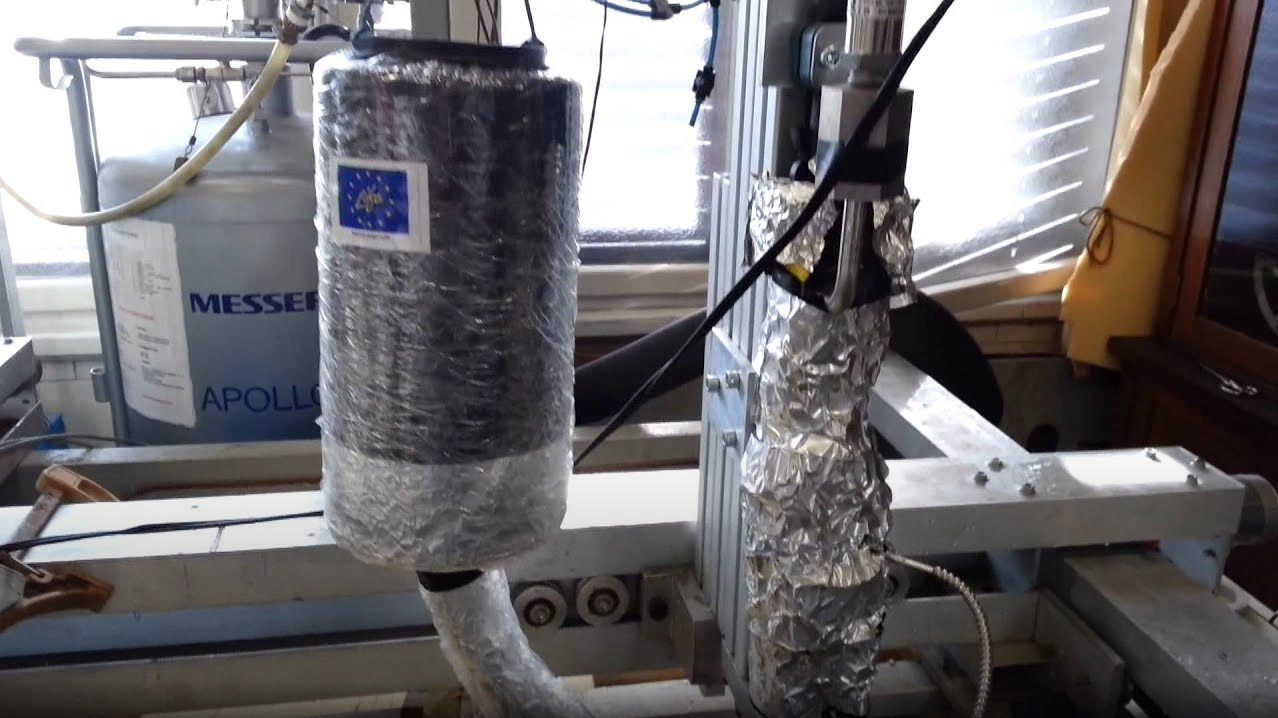
The particles are generated in a tank specially designed for this purpose by spraying water through four nozzles, which are supplied with water and air in an environment maintained at a temperature below -100°C by injecting liquid nitrogen into the tank. To achieve the correct size and quantity of ice particles, it is essential that temperatures do not fluctuate significantly and that the flow rates of the water and air injected through the nozzles are kept constant.
The transport system consists of a conical component that fits onto the outlet of the particle-generation chamber and conveys the particles through a tube, insulated from the outside, to the cutting head. This is one of the critical points of the technology, as the air circulating through this tube – which rises from the cutting head due to the Venturi effect created by the jet – is hot, causing a temperature difference that causes the particles to collapse at the inlet to the cutting head. This is resolved by channelling nitrogen from inside the tank through the transport tube.
Technology 2
The requirements for the development of this technology were quite different. One of the main objectives for this technology has been the design of a cutting head to freeze the water after it has passed through the sapphire, as well as the development of a system to cool the water under pressure before it reaches the cutting head; finally, another objective has been the creation of a system to recycle the water that has already been used.
Due to the nature of the process used, which requires liquid nitrogen to be injected directly into the head, it became necessary to design a new head that would offer the flexibility that conventional heads do not provide. A mixing chamber (the inner part of the nozzle head where the abrasive is normally injected) has therefore been designed to allow nitrogen gas (which is produced by the evaporation of the injected liquid nitrogen) to be released; otherwise, the jet could be altered if the gas were to remain inside.
Furthermore, and also due to the nature of the process, the high-pressure water must be cooled before it reaches the cutting head, so that there is no significant temperature difference between the water jet and the liquid nitrogen when the latter is injected. A glycol-water cooling system has been developed for the high-pressure pipe, which allows the water to be cooled to -15°C.
Alongside this technology, a water recycling system has been developed which involves the sedimentation of particles present in the used water, ensuring that the recycled water contains no particles larger than 100μm.
Ice Jet technology is aimed at the market segment between WJ and AWJ, and at applications where a clean manufacturing process is crucial (e.g. medicine, the food industry, etc.).